The Centre said media reports cannot form the basis for seeking review of the judgement since it is well settled law that courts do not take decision on the basis of media reports.

The International Olympic Committee on Wednesday confirmed it had received the letter.

Prime Minister Modi felt there were too many silos with no arrangement to take a comprehensive view on national security. The PM has entrusted NSA Ajit Doval to evolve a comprehensive roadmap and get it implemented, reveals Nitin Gokhale, Editor-in-Chief, Strategic News International.

The Narendra Modi government on Monday appointed Arvind Gupta, a former Indian Foreign Service officer, of the 1979 batch, as Deputy National Security Advisor. This appointment comes within days of Nehchal Sandhu quitting as deputy NSA, citing personal reasons.

It would be realistic to see India's position on the DGMOs joint statement more as 'engagement, different from dialogue', where our subsequent options could be decided depending on the realities of the situation on the ground, notes Rana Banerji, who headed the Pakistan desk at the Research and Analysis Wing, India's external intelligence agency.

'Project Big Picture' called for the biggest six clubs in the Premier League, along with three other long-term members, to be given 'special voting rights' that would effectively put them in command of the world's most commercially successful league -- and leave the rest as second-class passengers.

China for the first time has divulged the deployment of a nuclear submarine for anti-piracy operations in the Gulf of Aden, a move defence experts say could cause unease among neighbours, including India.
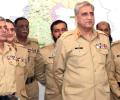
As many as 17 three star generals will retire before General Bajwa hangs his boots, says Rana Banerji, who headed the Pakistan desk at the Research and Analysis Wing, India's external intelligence agency.

'While economic ties are making incremental progress, it is in the security and strategic domains that the India-Japan synergy is more compelling,' says Dr Rajaram Panda.
'In the present era of strategic uncertainty and rapidly changing threats, no military professional now disputes the unavoidable necessity of a joint planning staff for the planning and conduct of joint operations so that integrated operations can be planned 'top down',' says Brigadier Gurmeet Kanwal (retd).

During their talks, the two leaders decided to significantly expand their ties in several key areas including defence, trade, energy and education.
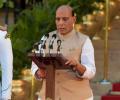
The new minister must commit himself to supporting long-term defence plans or else defence modernisation will continue to lag and the growing military capabilities gap with China will assume ominous proportions, warns Brigadier Gurmeet Kanwal (retd).

"We've vetting very, very strongly. Very, very strongly. But we need help, and we need help by getting that executive order passed," he said.
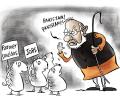
'India serves itself poorly with its latter-day discovery of Pakistan as an instrument in domestic politics,' notes Shekhar Gupta.
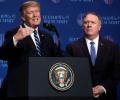
'Traditionally, the US tried to tamp down tensions whenever a crisis situation arose and deputed officials from Washington to travel to Delhi to counsel restraint.' 'This time around, no US envoy flew down to Delhi -- not even when tensions spiked and a flashpoint was reached last week,' points out Ambassador M K Bhadrakumar.
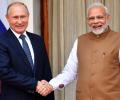
'Washington senses that the anchor sheet of India's strategic autonomy lies in its longstanding partnership with Russia, which remains firm and immutable despite the changes in world politics in the post-Cold War era,' notes Ambassador M K Bhadrakumar.<

Prime Minister Manmohan Singh and United States President Barack Obama will meet in Washington on Thursday to chart a course for "future cooperation" in areas such as civil nuclear technology, trade, investment, defence and counter-terrorism, amid perceptions that bilateral strategic ties have plateaued.

The plan hinged on two critical assumptions: India would not be able to replenish supplies quickly to launch a counter-attack. India could not respond in enough strength to dislodge the Pakistanis. Both assumptions would be proved wrong due to the ferocity of the Indian response, reveals former RAW officer Tilak Devasher in his new book, Pakistan At The Helm.

'This is the first time the US has formally recognised the threat India faces from terrorist organisations based in Pakistan.'

'Islamabad receives billions in aid from the US but continues to harbour terrorists,' he said.

'The range of purchases throw a light on India's threat perception as also its perceived role of being a stabilising influence in the region,' says Brigadier S K Chatterji (retd).

Here is the full text of the joint statement issued by India and the US.

How to deal with a country that has made export of terror a reason to make the world notice and fund it? Rediff.com contributor Sanjeev Nayyar offers a few suggestions

Modi also made a call for European Union unity and said India would play a positive role in enhancing that through Germany.
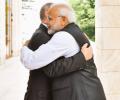
Modi said India and Russia have been friends for a long time and thanked Putin for inviting him for the first-ever informal meeting at Sochi.
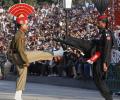
'Pakistan's capacity to carry a normal relationship with India doesn't exist.' 'The relationship with Pakistan is less important than several others.'

After weighing all the costs and benefits, the next administration is likely to reduce and restructure assistance to Pakistan but not to end it altogether, says Daniel S Markey.

Moving ahead with their new mantra -- Chalein Saath Saath: Forward Together We Go -- Prime Minister Narendra Modi and United States President Barack Obama on Tuesday vowed to deepen cooperation in every sector for the benefit of global stability and people's livelihoods over the next ten years.
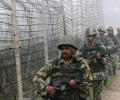
'For every act of terrorism on Indian territory for which there is credible evidence pointing to the Pakistan army and the ISI's involvement, carefully calibrated military strikes must be launched against the Pakistan army,' says Brigadier Gurmeet Kanwal (retd).
'It is in electronics that the gap between where we are and where we need to be is most obvious and most persistent.' 'It is not only a national security issue, but also a commercial issue,' argues Rajeev Srinivasan.
'The Senators were playing safe, not angering either the pro-India lobby or the pro-Pakistan lobby, but perhaps more importantly, the military-industrial complex -- the most powerful lobby of all -- which the majority of Senators are beholden to in terms of largesse to their campaign coffers.'

'Whether it's investments in Kashmir, building naval facilities, or selling top-of-the-range military equipment, Pakistan could well benefit more under Xi's watch.' 'Do Chinese concerns about the 'Islamisation' of Pakistan give it pause about how quickly to move forward with security and economic projects? At the moment the indication is quite the opposite: China is doubling down on its support to Pakistan, partly because of its fears about where the country is headed.'

In bilateral interfaces relations with China have also to be given due weight, opines Premvir Das

This is the joint statement issued by the ministry of external affairs on the visit of US President Barack Obama to India.

'It will make good sense for military men on that side of the table to be confronted by our own.'
